
Fishing forecast in Sheffield
Sheffield is built where five rivers meet – the Don, Sheaf, Porter, Loxley and Rivelin – plus the Sheffield & Tinsley Canal running alongside the lower Don. Pike, perch and chub hold the lower river and canal; wild trout and grayling have returned to the fast upper stretches after decades of industrial pollution. The bite forecast below tracks pike, perch, bream and carp.
Get the FisHub fishing forecast for Sheffield and prepare for your trip in advance. We factor in the weather and give you a forecast several days ahead, so you can plan your fishing.
Fishing forecast for today, 11.10.2026
Morning

Weather at morning: clouds, air temperature 8°C, feels like up to 6°C. Wind speed 3.23m/s. Atmospheric pressure 1011hPa. Humidity 87%.
Angler forecast: crucian and carp bite Perfect!. Bream bite Perfect!. Pike bite Perfect!. Perch bite Perfect!.
Midday

Weather at midday: clouds, air temperature 10°C, feels like up to 8°C. Wind speed 3.03m/s. Atmospheric pressure 1012hPa. Humidity 81%.
Angler forecast: crucian and carp bite Perfect!. Bream bite Perfect!. Pike bite Good. Perch bite Good.
Evening

Weather at evening: clouds, air temperature 12°C, feels like up to 11°C. Wind speed 2.46m/s. Atmospheric pressure 1013hPa. Humidity 59%.
Angler forecast: crucian and carp bite Good. Bream bite Perfect!. Pike bite Perfect!. Perch bite Perfect!.
Fishing forecast for tomorrow, 12.10.2026
Morning

Weather at morning: clouds, air temperature 10°C, feels like up to 8°C. Wind speed 2.45m/s. Atmospheric pressure 1012hPa. Humidity 94%.
Angler forecast: crucian and carp bite Perfect!. Bream bite Good. Pike bite Perfect!. Perch bite Perfect!.
Midday

Weather at midday: rain, air temperature 14°C. Wind speed 3.99m/s. Atmospheric pressure 1012hPa. Humidity 97%.
Angler forecast: crucian and carp bite Perfect!. Bream bite Perfect!. Pike bite Good. Perch bite Good.
Evening

Weather at evening: clouds, air temperature 17°C. Wind speed 3.46m/s. Atmospheric pressure 1011hPa. Humidity 98%.
Angler forecast: crucian and carp bite Good. Bream bite Perfect!. Pike bite Perfect!. Perch bite Perfect!.
Fishing forecast for the day after tomorrow, 13.10.2026
Morning
Weather at morning: clouds, air temperature 16°C. Wind speed 6.18m/s. Atmospheric pressure 1012hPa. Humidity 94%.
Angler forecast: crucian and carp bite Perfect!. Bream bite Perfect!. Pike bite Perfect!. Perch bite Perfect!.
Midday
Weather at midday: rain, air temperature 16°C. Wind speed 5.39m/s. Atmospheric pressure 1014hPa. Humidity 95%.
Angler forecast: crucian and carp bite Perfect!. Bream bite Good. Pike bite Good. Perch bite Bad.
Evening
Weather at evening: rain, air temperature 16°C, feels like up to 15°C. Wind speed 5.9m/s. Atmospheric pressure 1018hPa. Humidity 71%.
Angler forecast: crucian and carp bite Bad. Bream bite Good. Pike bite Bad. Perch bite Bad.
Where to fish in Sheffield
Sheffield is built where five rivers meet: the Don, Sheaf, Porter, Loxley and Rivelin all run through the city, more than almost anywhere else in England. The Don is the main line, flowing through Kelham Island and out east through Attercliffe and Meadowhall; the Sheaf and Porter join it from the south, the Loxley and its tributary the Rivelin from the west.
The Sheffield & Tinsley Canal, part of the wider Sheffield and South Yorkshire Navigation, runs alongside the lower Don from the city centre out towards Rotherham and Doncaster, giving still water where the rivers themselves run faster.
England has no public register of fishing waters – access on the Don, its tributaries and the canal runs through clubs like the Tin Mill Angling Club, which holds a stretch of the upper Don for fly fishing. Every name here is geography, not an invitation; check who controls a stretch before turning up.
History of fishing in Sheffield
Sheffield shaped national fishing law more directly than almost any other English city. By 1878 the city had 211 angling clubs and around 8,000 members, and it was Sheffield anglers who petitioned their own MP, Anthony Mundella, to push a close season for coarse fish through Parliament. The result, the Freshwater Fisheries Act 1878 – still known as the Mundella Act – set a legal close season from sunset on 14 March to sunrise on 16 June. That compromise, reached because Northern clubs and southern associations couldn't agree on dates, is the direct ancestor of the 15 March–15 June closure still in force on English rivers today.
The rivers those Victorian anglers fished were nearly destroyed by the century that followed. Steel works, paint factories and wartime armaments plants poured pollution into the Don; by the 1970s parts of the river ran yellow, and a 1970 photograph shows flames on its surface. Water quality legislation in the 1970s began a slow recovery, tracked by fish sightings through 2006–2015. In 2019, two Atlantic salmon were confirmed in the River Don – the first seen there in 220 years, since the species was wiped out by mill weirs around 1796.
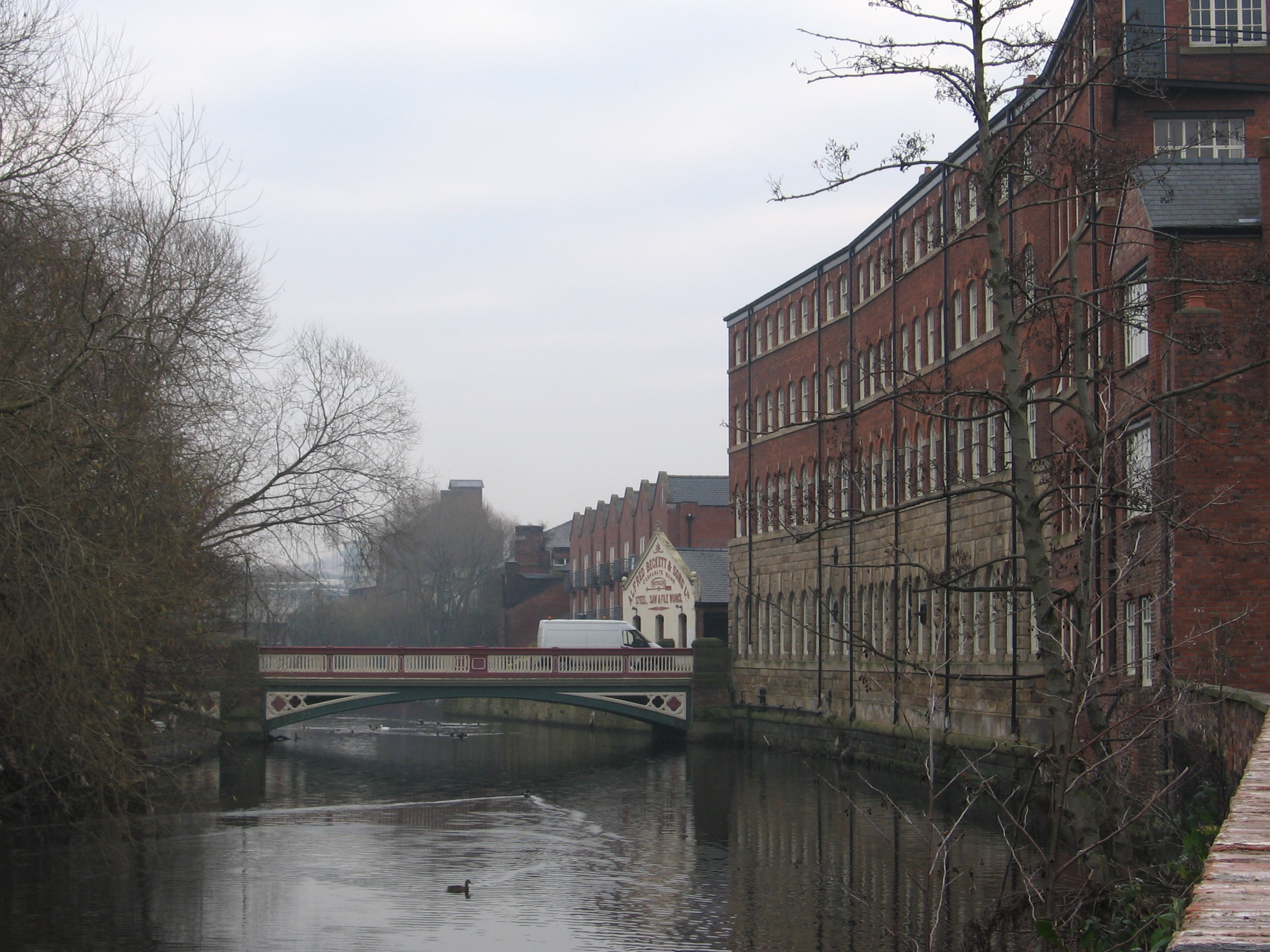
Photo: Dave Bevis, Wikimedia Commons, CC BY-SA 2.0
What's biting and how to catch it
The upper Don, Loxley and Rivelin hold wild brown trout and grayling in fast, stony water, closer to a Peak District stream than a city river; the lower Don and the canal run slower and support pike, perch, chub and bream. The bite forecast below tracks pike, perch, bream and carp – the same four species tracked everywhere on FisHub, though the trout and grayling water upstream sits outside what it covers.
On the fast upper stretches, a light fly rod with a short line suits the tight, overgrown swims; on the lower Don and canal, ledgering with maggot or worm takes chub and bream, while spinning with a small lure works the pike-holding pools below weirs.
How to read the bite forecast
The index below scores air pressure and its trend for pike, perch, bream and carp – the same principle everywhere on FisHub.
Sheffield's rivers respond fast to rain over the Peak District moors upstream: the Don, Loxley and Rivelin can rise and colour within hours of a heavy fall, well before it's raining in the city itself. The canal, buffered by locks, reacts far more slowly and reads closer to the forecast's pressure trend on its own.
Seasonality of fishing in Sheffield
Rivers close for coarse fish and eel from 15 March to 15 June under national rules – the same close season Sheffield anglers themselves set in motion in 1878, now applying to the Don, Sheaf and their tributaries. The Sheffield & Tinsley Canal, like other enclosed still waters, stays open all year.
Autumn brings the strongest activity on the lower Don and canal as pike and perch feed up before winter; the trout and grayling water upstream fishes best from spring through autumn, before hard winter frost thins the fast, shallow stretches.
What practitioners say
Local fly-fishing guides covering the Don rate the river's recovery as one of the most complete of any English city river, with wild brown trout and grayling now holding in stretches that were fishless as recently as the 1980s. Their standard advice for the upper Don and Loxley is a short, accurate cast into pocket water behind boulders, where trout hold tight to cover in the faster current.
Questions and answers
Do I need a licence to fish in Sheffield?
Yes – an Environment Agency rod licence from age 13, plus permission from whoever controls the specific stretch, since England has no public register of fishing rights.
Why does the close season for English rivers start on 15 March?
Because Sheffield anglers set it there in 1878: the Freshwater Fisheries Act, pushed through by the city's own MP Anthony Mundella after a petition from 211 local angling clubs, fixed the dates still used today.
Can you really catch trout in Sheffield city centre?
On the upper Don, Loxley and Rivelin, yes – wild brown trout and grayling have returned as water quality recovered from decades of industrial pollution, and salmon were confirmed in the river in 2019 for the first time in 220 years.
What fish does the bite forecast below cover in Sheffield?
Pike, perch, bream and carp, mainly on the lower Don and the canal – the trout and grayling water on the upper rivers sits outside what the index tracks.
More fishing nearby
The basics of a fly rod and monofilament line are on the FisHub wiki, along with the centrepin reel classic Yorkshire float anglers still use. More UK fishing forecasts are on the overview page, including Nottingham, not far away.