
Fishing Calendar September 2026: Best Days to Fish
September breaks the habits the summer taught us: yesterday the fish were sitting in the weed, today they are already glued to the shelf or to the mouth of the deeper hole. Anglers who adjust their lure, their retrieve speed and their swim in time still catch, even after a sharp drop in temperature.
Why September changes everything
The water cools in layers, mostly overnight, and daytime warming is no longer dependable. The summer thermocline weakens and breaks up, the water column mixes far more, so fish switch depth more often and move to wherever oxygen and food come together.
Predators hunt less in full darkness and feed more and more during the day, once the water picks up a little warmth. Pike and zander follow the shoals of silver fish, while perch give themselves away with short bursts of activity over plateaus and gravel points. Chub stay high in the water as long as the days remain mild.
Lures are worth sizing up gradually: the small summer shad or a tiny crankbait does not reliably select the better fish. Silver fish also move onto richer food, and bigger baits save the time that would otherwise be lost to small-fish bites.
What bites best in September
Pike and zander
Look for pike along marginal shelves, near lily beds, in the remains of the weed and at the exits from shallows into deeper water. For twitching, jerkbaits around one hundred and twenty-five millimetres work well, with smaller models kept in the box for passive fish. Zander hold the edges of the main channel, hard bottom and the areas around bridges, and they respond better to a slow retrieve close to the bed. Which rod suits that job is covered in our guide to spinning rods.
Perch and chub
Perch shoal up in September and become far easier to locate: a swirl on the surface, fry scattering, birds circling overhead. Small soft plastics on a light jig head or a drop shot rig, and above all a willingness to keep moving between spots. Chub carry on taking insects, small surface lures and bread for as long as the days stay mild.
Bream, roach and skimmers
Silver fish gather on the deeper, more even stretches where the flow is steadier. Autumn groundbait wants to be nourishing and binding rather than bulky and dusty, and hookbaits are best presented finely, on a discreet hook. This is exactly the month when measured feeding pays better than a carpet of bait: there is still plenty of natural food about. On tackle, see our notes on feeder rods.
Carp
Carp feed hard before winter and move a great deal, which makes searching more productive than waiting. Margins, fallen trees and clean bottom edges beat the swim chosen out of habit. The amount of bait, though, is scaled back as soon as the leaves start to fall — natural food takes the value out of any large bed of feed.
Fishing calendar for September 2026
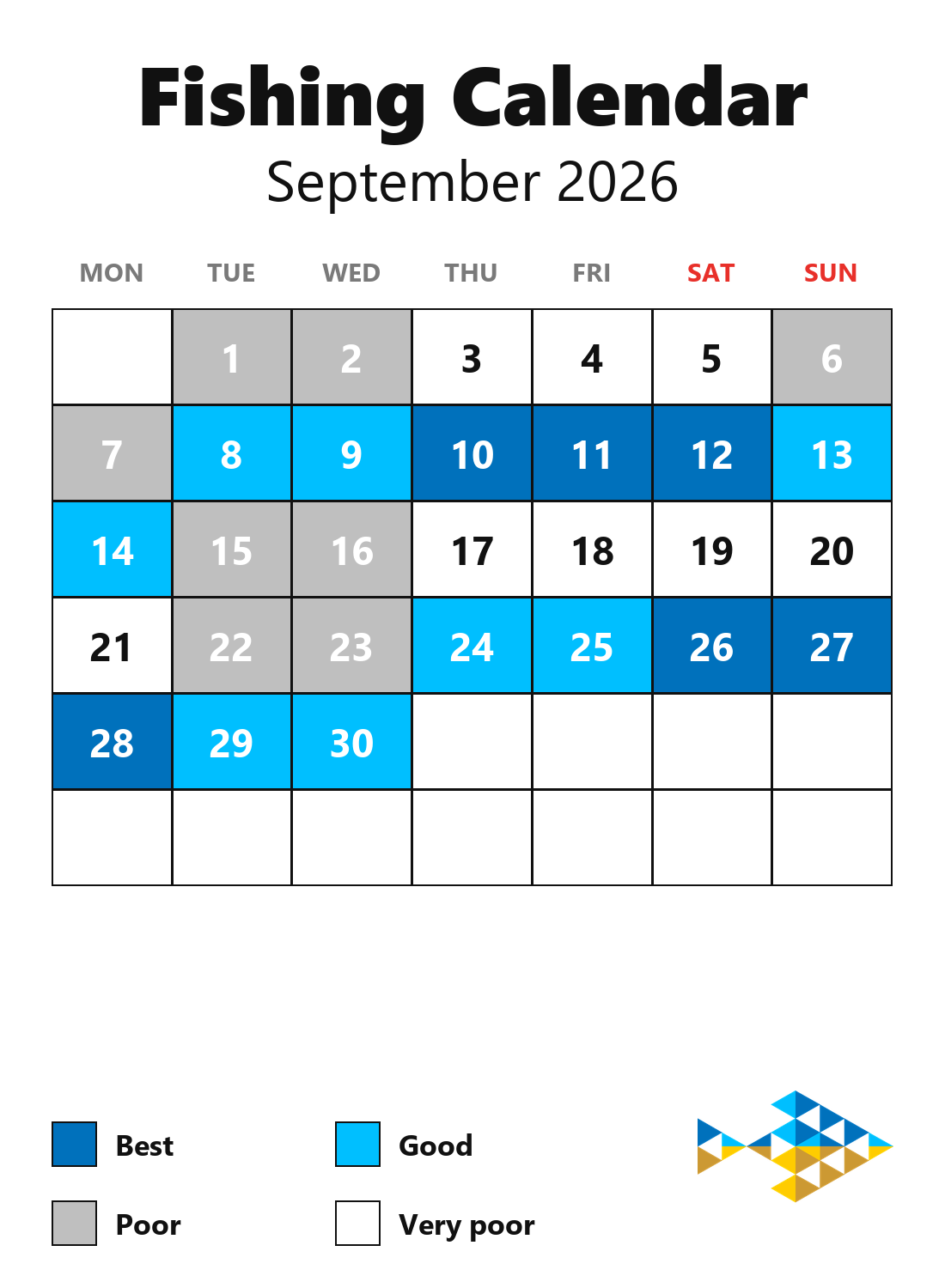
| Best | 10–12 and 26–28 September | new moon on the 11th, full moon on the 27th |
| Good | 8–9, 13–14, 24–25 and 29–30 | steady bites in settled weather |
| Poor | 1–2, 6–7, 15–16 and 22–23 | short feeding spells, long quiet periods |
| Very poor | 3–5 and 17–21 | proven swims only |
Best days to fish in September
The best windows are 10–12 and 26–28 September. The first falls on the new moon of the 11th, the second on the full moon of the 27th. On those stretches it is worth planning a full day on the bank rather than a short couple of hours.
The 8th and 9th, 13th and 14th, 24th and 25th, and 29th and 30th will be good. These are sound dates for feeder work, lure fishing and carp sessions, particularly if the weather avoids sharp swings in pressure, wind or temperature. Expect steady bites, but do not expect the fish to find your hookbait on their own: the swim and the presentation still have to be earned.
The 1st and 2nd, 6th and 7th, 15th and 16th, and 22nd and 23rd look poor, and the 3rd to 5th and 17th to 21st look genuinely bad. On days like those fish feed briefly and then go quiet for a long time, so it pays to fish tight to a feature: a known shelf, sunken timber, a crease in the flow, or wherever the prey fish are holding.
The moon phase does not replace real conditions on the water, but it does help choose a date. Around the new and full moon the night-time light levels and the general rhythm of feeding change, and bites are often more pronounced. A cold front, coloured water or a rapid drop in level can, however, cancel out even the strongest day on the calendar. How differently the days fall across the year is easy to see in the fishing calendar for 2026.
For a weekend, the best choice is 12–13 or 26–27 September. The first option gives one very good and one good day; the second covers the strongest stretch of the month together with the full moon.
What experienced anglers advise
We went through videos from British anglers and pulled out what works specifically at this time of year.
Angling Direct TV
Their masterclass on feeder fishing for river bream is built around discipline rather than gear. Three larger feeders go in first to establish a baited area quickly, and only then does a fourth rod fish over it. Casts are short and timed — around three minutes, tracked on a stopwatch — so the feed rate stays honest. The groundbait is a fifty-fifty mix, made slightly drier for feeders so it flakes off and clouds. The point that most anglers miss: balance the feeder so it holds only lightly and is allowed to roll a little, because that is what turns a dead tip into a readable nod-then-drop-back.
Mainline Baits
The guide to solid PVA bags is mostly about removing air and guesswork. Slow-melt PVA goes on for depths beyond about twelve or thirteen feet, normal melt for shallower water. The mix aims for eighty to ninety per cent pellets across several sizes so the bag packs dense with no air pockets. Bags are built in layers with the lead set centrally, then compressed hard. Hookbaits stay small, ten to twelve millimetres, with minimal buoyancy so they sit inside or just on the bag. And when bites are sporadic, they fish single bags repeatedly over the spot instead of continuing to spod.
Winning Ways Basics
Their introduction to bolo fishing covers the river float approach that suits autumn currents. A long bolo rod of four to six metres with a closed-face reel gives line control at distance, and the spool is deliberately loaded only half full to stop tangles. The float is a slim stick of three to six grams, matched to the flow. Instead of distributed shot they build a forward bulk with an olivette and stops, so a change of depth does not mean moving shot around. Feeding is a concentrated mix of hemp and casters on a short line, fed regularly.
Frequently asked questions
When should I go fishing this month?
The best periods are 10–12 and 26–28 September. For a weekend, 12–13 or 26–27 September are the easiest to plan around.
What should I do on the poor days?
Do not wander from swim to swim at random. Fish proven spots, slow the retrieve down, feed more accurately, and move to larger or more visible baits depending on the species you are after.
Does the monthly calendar match the forecast for my area?
Not always. The calendar shows a general probability of activity, while the weather where you live can change everything: wind, pressure, water temperature, river level and clarity all count for more.
See also
- Fishing calendar 2026 — moon phases across the whole year;
- Fishing calendar January 2026 — for comparison with the winter spread of days;
- Feeder rods — what matters for autumn feeder work.


