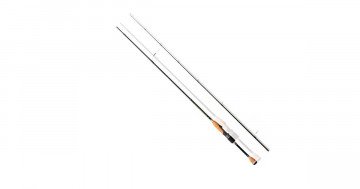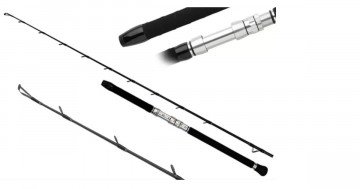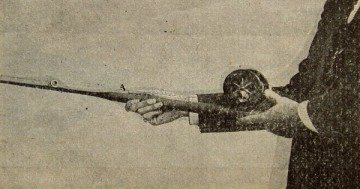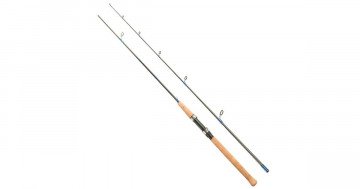
Spinning rods: casting weight and action
Spinning is fishing on the move: the lure is cast, worked and cast again, dozens of times an hour. The rod does not wait for a bite here, it works continuously, and everything about it follows from that.
What a spinning rod has to do
Three things are asked of the blank at once: put the lure where you want it, pass into your hand what is happening to it underwater, and let you steer it with pulls and pauses. The second is what sets spinning apart most — the rod works as a sense organ, not only as a lever.
That is why spinning blanks are made stiffer and lighter than most, and why length is limited by how many hours you can hold one.
Casting weight matters most here
In spinning the rating counts for more than in any other type, because the blank itself throws the lure, loading up on its weight. Outside the range it does not work: a light lure never bends the blank and falls short, a heavy one overloads it on every cast.
So a spinning rod is chosen not „for the fish" but for the weight of lures you intend to use. The ranges are covered in Spinning rod ratings.
Action decides how you steer the lure
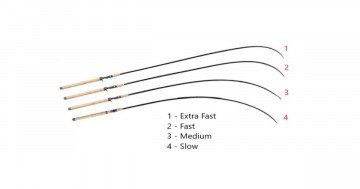
A fast blank transmits a twitch sharply and precisely — what you need for retrieves with pauses and jerks. A slower one absorbs the fish's runs more gently and breaks fine leaders less often, but is harder to steer a lure with.
This is not a better-or-worse scale but a choice made for the retrieve. Details in Spinning rod action.
What spinning is not
A spinning rod is not universal. It works badly with a heavy static rig, which needs reserve power rather than sensitivity, and it is wrong where you fish natural bait and wait — there a feeder or a float rig wins.
A spinning rod is chosen for the lure, not for the water. The same river calls for different blanks depending on what you fish it with.
Rod and reel work as a pair
A spinning rod is designed either for a spinning reel or for a baitcasting reel, and the two are not interchangeable: the seat sits differently and the guides are spaced differently. A baitcasting blank has smaller guides on top; a spinning blank has larger ones underneath, especially near the handle.
Fitting the wrong type is technically possible but leaves the setup working worse than either: the line meets the blank at the wrong angle and starts wearing against the guides.
Common mistakes when choosing
The first is taking the widest possible rating „so it covers everything". A wide range means the blank works well somewhere in the middle and nowhere at the ends. The second is taking too long a rod as a first spinning outfit: it casts further but tires the arm faster than you can work a swim. A spinning rod that is uncomfortable to wave for an hour catches nothing, however well its rating is chosen.
What is in this subcategory
Separate articles cover construction, kinds, length, material and history of spinning rods. Features shared by all types — in Fishing rods.