
Fishing Calendar November 2026: Best Days to Fish
November gives English anglers very little warning. A mild, grey week can be followed by a bright, frosty one, and the fish answer the change before the car is loaded. This is the month to shorten the session, slow everything down and fish the hours when the water is least cold.
Early winter on English water
Level and flow still come first. The Nene through the fens at Peterborough is managed for drainage, so a sluice or pumping station can change level and flow under a clear sky, and on the Thames in London the tide, rising and falling twice a day below Teddington, moves fish further than the weather does, say our Peterborough and London pages.
Deep water is different: our Bristol page says it holds its temperature better than a river does. Bristol's big reservoirs, Chew Valley Lake and Blagdon Lake, are best known for trout, so the forecast score says little about them.
What bites in November
Pike
The winter notes on our Bristol, London, Nottingham, Peterborough and York pages all name pike and perch as the fish that keep going. Peterborough's adds that the drains fish better than the main river when it is moving hard. The pace is what changes: our note on paddle tail lures says that on too slow a retrieve the tail stops working, and that in cold water a curly-tailed lure stays alive where a paddle tail does not. You can check a paddle tail by working it in clear water at the edge.
Perch
Perch hold to structure: the Bristol and London winter notes put them on it, and the Nottingham one puts them on the canal. In coloured water our note on the lateral line and the lure says a lure has to be worked past the fish. That means denser casts and a slower pace, not a louder lure.
Bream
Bream sit in deeper, slower water: the London page has them in the Lea Navigation's deeper stretches, answering to steady feeding. The Peterborough page says a fen shoal takes time to settle over bait and then feeds hard, so constant recasting costs the session. Our guide to feeder rods explains the fine tip that acts as the bite signal.
Carp
London's canal carp are wary: the water is clear, the footfall constant and there are anglers before you. The London page says short, quiet approaches beat heavy baiting there. On small day-ticket waters the Bristol page advises a rod chosen for accuracy at short range, and our guide to the length of carp rods lists the short ones.
Fishing calendar for November 2026
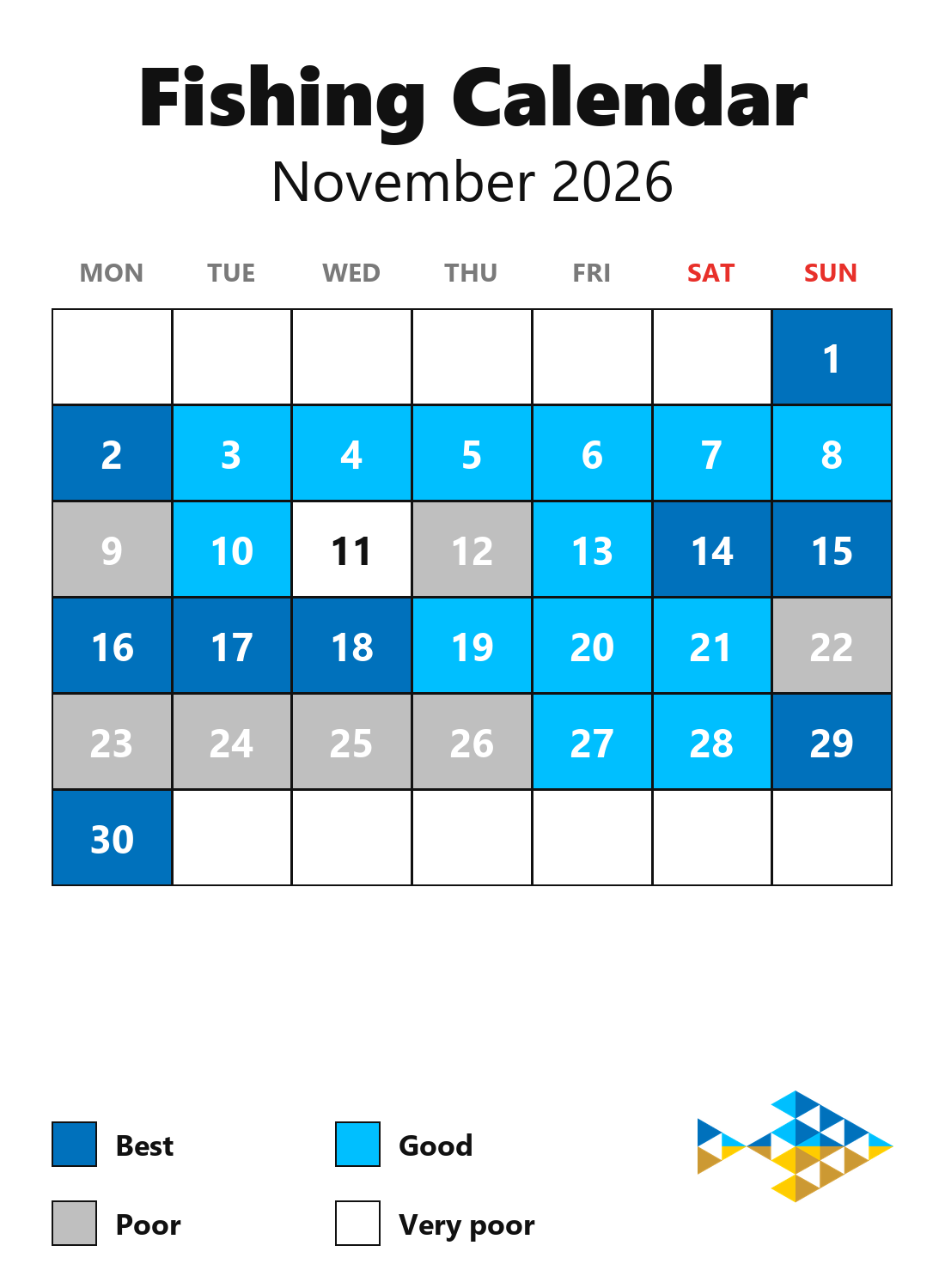
| Best | 1–2, 14–18 and 29–30 November | longest run is the 14th to 18th |
| Good | 3–8, 10, 13, 19–21 and 27–28 November | six in a row from the 3rd |
| Poor | 9, 12 and 22–26 November | full moon falls on the 24th |
| Very poor | 11 November | a single day, a Wednesday |
Best days to fish in November
The best days are 1–2, 14–18 and 29–30 November. The first two carry on from 30–31 October, so the weekend of 31 October and 1 November is best on both days; the October calendar covers the days before. The longest run is Saturday the 14th to Wednesday the 18th, a full weekend plus three weekdays.
Good days are 3–8, 10, 13, 19–21 and 27–28 November. The six from the 3rd to the 8th are the longest good run and include the weekend of the 7th and 8th. The 9th to the 13th is a choppy spell: poor on the 9th and 12th, very poor on Wednesday the 11th, with good days on the 10th and 13th.
The longer poor stretch is 22–26 November, Sunday to Thursday, with good days on the 21st and 27th either side. Keep sessions short and on known water there.
The new moon on Monday the 9th and the full moon on Tuesday the 24th both land on poor days, so in this calendar neither phase makes a day better; the table also takes the season into account.
The weekend to plan around is 14–15 November, both best days. Sunday the 1st is best too, Sunday the 29th is best with a good Saturday before it, and 7–8 are good. The weekend of the 21st and 22nd is the weak one: a good Saturday, a poor Sunday.
What experienced anglers advise
The Ginger Fisherman: canal pike in a cold snap
The Ginger Fisherman fished a canal after the temperature fell from about 15°C two days earlier to minus one overnight, under bright sun and flat calm. By his account fish in those conditions are not feeding heavily or chasing high in the water, so he drops the summer jerking and twitching and runs the lure at a steady, gentle pace, about halfway down in a canal only around four feet deep. Pike crept up and took it from behind. When one follows without taking, he drops the lure in front of it and rattles it on the bottom, which he says can be the difference between a blank and a fish.
Rob Wootton Fishing: winter method feeder
Rob Wootton Fishing gives five winter method-feeder tips from a shallow lake. He scales the feeder down and feeds 3 mm pellets rather than 2 mm so fewer particles are left behind: in winter, he says, fish do not want to settle over a big bed. His hooklength is a supple 0.14 mm, against something like 0.18 to 0.20 mm in summer, kept to two inches. After cold mornings he expects the feed in mid-afternoon, so he starts at about 50 metres and inches out to the 65-metre line mid-lake. He keeps the quiver tip straight and the line slack.
DNADIGITALTV: autumn carp
DNADIGITALTV features Steve Carrie of DNA Baits on carp in mid-autumn, when he says the fish have been hammered all summer and are wary. He looks for where natural food is running out: silt gullies full of bloodworm, mussel beds and the last patches of living weed with snails. In weed he fishes a single hookbait on a chod rig where fish are feeding rather than casting to a clear spot nearby, and avoids floral flavours other than a subtle milky malt. The hookbait is a pop-up.
Frequently asked questions
How many pike can I take from a river?
On rivers in England the Environment Agency's rules allow one pike up to 65 cm a day to be kept; any other pike goes back unharmed. Measure from the tip of the snout to the fork of the tail. Gaffs and tailers are banned, and a fish hooked anywhere other than the mouth or throat must be returned alive. Those limits are for rivers; local byelaws and private fisheries can add rules.
Which lead weights are legal?
In England lead weights may only be used if they weigh 0.06 g or less, or more than 28.35 g. The Environment Agency gives lead shot sizes 14 to 8 and lead weights over 1 ounce as its examples, and says lead is toxic to birds. Our note on lead and its alternatives covers what else weights are made of.
Do I need a special permit to fish the Thames in London?
For the locks and weirs, yes: the Environment Agency says you need an additional permit on top of your rod licence. Everywhere else on the river you still need permission from whoever holds the fishery, as our London page points out.
See also
- Fishing calendar October 2026 — the month before, which ends with two best days;
- Fishing calendar 2026 — the whole year in one place;
- Fishing forecast in the United Kingdom — bite forecasts for ten English cities;

