The hardbait lip and its diving depth
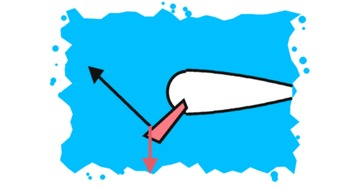
The lip is a plate at the front of the body, set at an angle to the flow. It turns the pull of the line into downward force on the lure: the angler pulls forward and up, and the hardbait goes forward and down as a result.
Angle decides the depth
The closer the lip lies to the body axis — the flatter it sits — the stronger the vertical pull, and the deeper the lure runs. A lip set almost vertical barely pulls down, but rolls the body side to side more strongly instead.
So depth and the width of the roll are one trade-off, not two independent traits: the same plate cannot pull down and roll sideways at full strength at the same time.
Area decides the drag
A large lip catches more flow: the lure runs deeper, but pulls noticeably harder on the rod and takes more effort. A small lip starts working more easily and at lower speeds.
Line also changes the depth
Diving depth does not depend on the lure alone. A thick line picks up more drag in the water and stops the hardbait from reaching its full depth, a thin one does not. For the same reason a long cast takes the lure deeper than a short one: more line in the water, a longer working stretch. Line itself has a separate section.
The lip starts working from the first metre
The lure does not reach its depth right after the cast: first it has to build up speed, and for the first few metres of the retrieve it runs above its working depth. On a short cast that stretch eats up a noticeable part of the whole retrieve.
Speed has a limit
Up to a point, a faster retrieve drives the lure deeper: the flow on the lip is stronger, the downward push greater. Beyond that there is a limit past which the hardbait starts to lose its rhythm and ride up — speed stops working for depth and starts working against it.
The lip as protection against snags
It sticks out ahead of the body and so hits a rock or a branch first — the lure bounces off instead of hooking into it. That same bump knocks the lure off rhythm, and it is often what comes just before a take.
The depth on the box is a reference, not a promise
The maker measures diving depth on their own line, at their own cast length and their own speed. Change any one of those, and the number shifts. It is taken as a reference for comparing models against each other, not as a promise of an exact depth on your own tackle.
When there is no lip
A lure with no lip behaves differently in every way: different buoyancy, different motion, different presentation. This is a separate class — the lipless hardbait.