Artificial lures: how they work
An artificial lure has no nutritional value and no scent of live prey. Everything it works with is movement, flash and sound in the water, and that is why it is judged by how it behaves on the retrieve, not by how closely it resembles a fish in the hand.
How it differs from bait
Bait works slowly: the fish finds it by scent and taste, approaches, tries it, and that is the moment the hook sets. An artificial lure has no such time — it passes the fish in seconds and has to work in that short stretch.
Hence the main practical difference: bait is cast and left to wait, a lure is worked. A lure lying motionless on the bottom does nothing — the angler gives it movement with the rod and the reel.
Three ways to draw attention
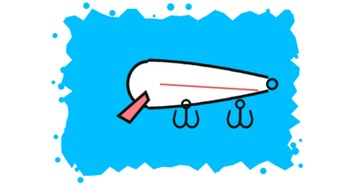
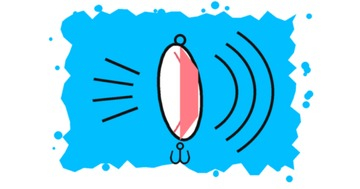
The first is the lure's own action: a tail, a paddle or the body shape turns an even pull of the line into an uneven movement of the lure. The second is light: polished metal and a glossy finish reflect it in short flashes. The third is vibration in the water, which fish sense with the lateral line rather than the eyes.
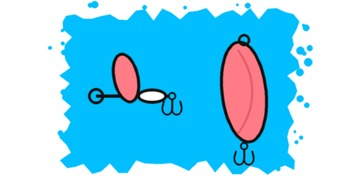
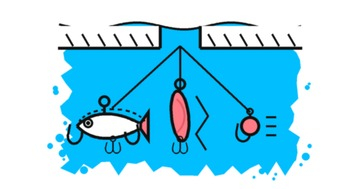
A single lure usually relies on just one of these, and this is how lures split into classes: for soft plastics the main thing is a soft action, for a spinner or spoon it is metal and flash, for a surface lure it is the trail and splash left in the surface film.
What they are made of
Hard lures are made of plastic and wood, metal lures of brass, copper and lead alloys, soft ones of PVC with a plasticiser, and fly-fishing flies are tied from feather, fur and synthetic thread on a hook.
The material here is not a finishing detail but what determines behaviour: metal sinks on its own, wood floats, soft plastic weighs almost nothing and stays in place without added weight.
A lure is the end of a system, not the system
The same lure works differently on different tackle: a stiff rod passes on a jerk more sharply, a softer one smooths it out; braided line carries the hand's movement in full, monofilament absorbs part of it.
So the question "which lure is better" has no answer without the tackle, the rig and the knot: a lure only delivers what actually reaches it through the line.
What a lure does not do
It does not search for fish on the angler's behalf and does not fix a mistake in the spot or the depth range: a lure worked where there are no fish performs flawlessly and gets no takes at all. And it does not make up for the wrong weight — a lure that has not reached the right depth does not work, it just drifts above it.