Soft plastic shapes
The angler pulls the line evenly, but the lure has to move unevenly — otherwise it just slides through the water side-on. Shape is the mechanism that turns one kind of movement into another, and it is the first thing soft plastics are classified by.
What the tail does
A tail is a surface set at an angle to the flow. Water presses on it from the side, the tail deflects, the deflection drops the pressure, the tail swings back — and the cycle repeats for as long as the lure keeps moving.
Hence the main limit: without movement the tail stays silent. A lure lying on the bottom does not work at all, and during a pause only what the fall manages to finish still counts.
Curly tail versus paddle tail
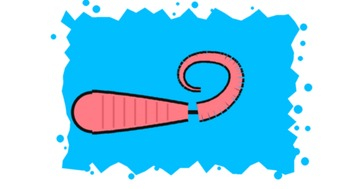
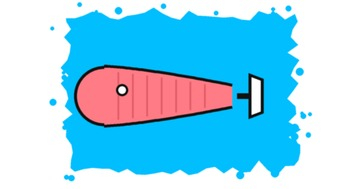
On a curly tail grub the tail is crescent-shaped and thin at the joint — it starts working at the slowest speed and traces an arc. On a paddle tail lure a stiff heel-shaped paddle sits at the end and beats rhythmically, but it needs a certain speed just to start moving at all.
These are different tools, not a worse one and a better one: the first works where the retrieve has to be slowed to a minimum, the second where a steady, noticeable rhythm is needed.
Shapes with no action of their own
A worm, a slug, a crayfish imitation and a larva have no action of their own at all — they move only the way the angler works them with the rod. This is not a shortcoming: shapes like these are used where a rhythmic action is unwanted and what is needed instead is an uneven, broken movement with stops. That is why they are more often fished on rigs where the weight sits separately: the rod gives the movement, not the speed of the retrieve.
The body is a shape too
Ribbing around the body increases its surface area, and a thin joint between body and tail makes the tail move more freely at the same speed. A thick body holds the hook more securely, a thin one tears sooner but sits on the hook more precisely.
Shape decides whether the point can be hidden
An offset hook disappears into the body completely only when the body is thick enough: on a tall paddle tail lure a slot is even cut along the back for this. On a thin worm or a narrow slug the point comes out on the outside, and the lure stops being weedless.
So in snaggy water the shape is chosen not for its action but for whether the hook can be hidden in it — an action that stays behind on a snag is no use to anyone.
Shape and retrieve are linked
Shape is not chosen on its own but together with how the lure will be worked: a steady retrieve brings out the paddle, a hop-and-drop retrieve brings out the fall and the curl, and a twitching retrieve works equally well with a shape that has no action of its own. A shape that does not match the retrieve simply never switches on.