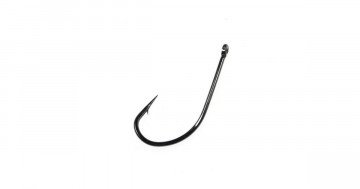
Hooks: parts, sizing and types
The hook is the only part of a setup that touches the fish, and the cheapest part of all. That is why choosing it is often left until last, even though it decides whether the fish stays on after the strike.
What a hook is made of
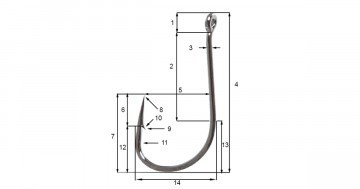
A hook has four working parts: the eye, which attaches it to the line, the shank — the straight section from eye to bend, the bend itself, and the point with its barb. Each governs something different: the eye sets how it is tied, the shank how bait sits on it, the bend what size of fish it is built for, the point how easily it penetrates.
The parts are covered in detail in Hook components, and the general definition in Fishing hooks.
Why there are so many ways to sort them
A hook is not described by one property but by a set of independent ones. The shape of the bend says nothing about the eye angle, and the number of points says nothing about intended use. Two hooks can match on one feature and be nothing alike on another.
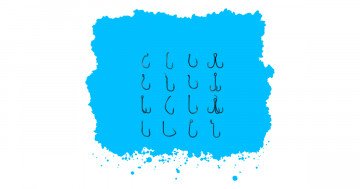
Each feature is covered separately in the subcategory Hook types.
Sizing: why the numbers disagree
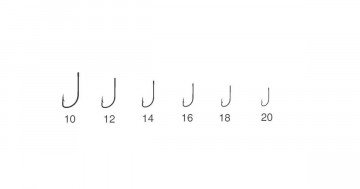
Hook size is given as a number, but there is no single numbering standard. Manufacturers use different scales, and a hook with the same number in two catalogues can be a different size. Compare by actual dimensions, not by the figure on the packet. How the scales work — in Hook sizing.
Match the hook to the leader, not to the fish
A common mistake is choosing a hook for the size of fish expected. In practice it is matched to leader thickness and bait size: too large a hook is more visible and hooks up worse, too small a one opens out under a load it was never built for.
The hook is also tied to the knot: not every knot suits every eye type. Hook knots have their own subcategory in Fishing knots.
Sharpness matters more than shape
Even the best-chosen hook does not work once it has dulled. The point goes not on fish but on the bottom: stones, shell beds and sunken timber wear it down in a few casts, and the angler never sees it happen.
The check is simple and needs no tools: draw the point across a fingernail without pressing. A sharp hook catches and leaves a mark; a blunt one slides. A hook that slides gets replaced — sharpening it at the water usually takes longer and works worse than tying on a new one.
The second reason a hook stops holding is opening out. That means it was taken for the wrong load, not that it is faulty: fine wire is built for delicate fishing and opens on a big fish by design, not in spite of it.
What else is in this category
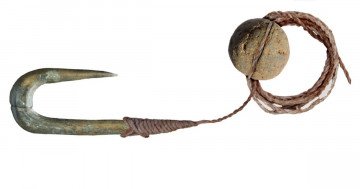
Besides construction and sizing, the category holds Interesting facts about hooks — on where the shape came from and how hooks are made. What the hook is tied to is covered in Fishing line.