Ice spoon fishing: lift and let go
Spot is a whole row of holes, and none of them is precious on its own. Presentation is the spoon dropping down by itself. Rhythm is a lift and a pause, repeated the same way. Exit is after the same number of cycles as on the previous hole, even if nothing happened.
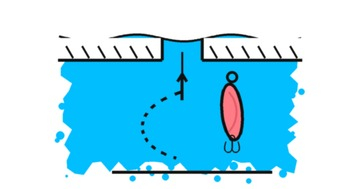
A jigging spoon doesn't go straight down: let go, it swings out to the side and turns over. That's why the pause is what fishes in this method.
What the person does
Lifts the lure and lets go. That's all. The lift isn't a retrieve — it's a way of raising the spoon to a height it can fall from; the actual work happens after the hand has stopped. The lift-and-pause cycle is a card of its own.
Why this is a fast method
A spoon is heavy and falls quickly, so the water column gets checked in a handful of cycles. A hole is judged by cycles, not by time spent sitting — which is exactly why spoon fishing is for finding fish rather than waiting them out. This speed is the method's main property: it answers the question "is there anything here at all".
A series of holes instead of one
The method is built around a row of spots: drill several holes, work them with the same number of cycles, and come back to wherever there was a touch. How that's done comes next.
A jigging minnow — same method or a different one
The same one: the person lifts and lets go. The difference is how much area the lure covers in one cycle, and exactly how it does that is covered in the lures root. For the angler this means one thing: with a jigging minnow, a hole gets judged faster, because it also checks the ring of water around it.
What this method can't do
A fine, subtle presentation. A heavy spoon doesn't show a cautious touch and can't hold still in one place — where fish are sluggish and packed tight, it gets swapped for an ice jig.
Why the vertical matters
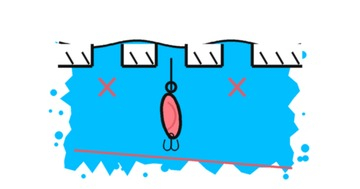
The line has to run straight down from the hole. If it's pulled to the side — by current, by wind, or by the angler stepping away — the spoon falls off to one side under the ice and comes back somewhere other than where it went in. The whole action disappears, even though the hand does exactly the same thing. So you stand square over the hole and let the line out from the same point it entered the water.
What it costs
Work with the auger. The method lives on a series of holes, and every hole means drilling — over a day that adds up to more than the fishing itself. The second cost is a coarse presentation: a heavy lure simply doesn't pass on a cautious touch, and how many of those go unnoticed, the angler never finds out. That's why spoon fishing means walking the ice, not sitting on it.