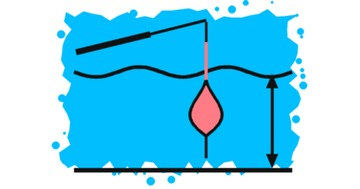
Fixed floats: depth set by the rod
A fixed float is held on the line without moving — by silicone tubing, an adaptor or a loop — and does not run along it. From that follows the main limit, and nothing gets round it: the fishing depth cannot exceed the length of the tackle.
Why depth runs into the rod
To get a fish out of the water you have to lift the rig. If there is more line between float and hook than the rod and line together, there is nowhere to lift it to: the hook stays under water while the float is already up against the tip ring.
This is geometry, not a feature of one model: depth is counted against the length of the rod. So a fixed float lives where the depth is less than the tackle — and that is exactly why deep water has the slider.
What a fixed attachment gives
The depth is set once and does not shift on the cast. The rig arrives at the spot assembled, the float cocks straight away rather than after the line has drawn through an eye. The strike goes home with no slack to take up.
So where the depth allows, a fixed rig wins on speed and accuracy — not on being “simple for a beginner”, as it is usually described.
Three ways to fix it
Silicone tubing — short lengths of tube pushed onto the stem; the float is held by friction and moved by hand. An adaptor — a removable fitting with a clip that lets you change the float without breaking the rig down. A loop — the line simply threaded through the eye and pulled tight.
The less a fitting pinches the line, the longer that line lasts: the pinch point is the first place where line remembers a kink.
What goes first
Tubing cracks in sun and cold and stops gripping — the float starts to slip, and the depth changes quietly in the middle of the session. An adaptor with a worn clip does the same.
Check by hand: the float should move along the stem with noticeable effort. If it slides freely, the tubing needs replacing, and that is five seconds against a ruined session.
Where it loses
In water deeper than the tackle it does not work at all. In a strong wind a short fixed-float rig holds its spot less well, because the line from rod tip to float is taut and catches the wind.