Jigging spoons: shape and balance
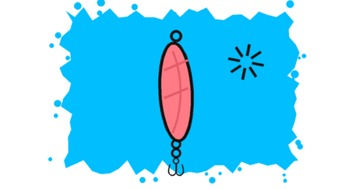
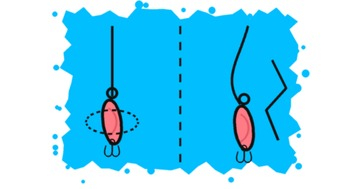
A jigging spoon is a narrow, solid metal body hung from the front end. It also moves sideways, but differently from a jigging minnow: that one swings out from under the hole on the lift and comes back, while a spoon drifts off on the free fall — and that fall is the action.
How it differs from a casting spoon
A casting spoon gets its action from the current pushing against it on the retrieve. Here the reel makes no current at all: the lure falls through still water and makes its own flow of water past it — through its own weight. That's why the body is made narrower and heavier than a summer metal lure of the same size.
Two ends of the class
A wide, light plate falls slowly and drifts far off vertical — it glides. A narrow, heavy one drops almost straight down; in Ukrainian these are called tsvyakhy, “nails.” The whole class sits between these two ends, and the middle works either way.
What the tie point decides
A spoon is hung from a hole or a ring at the nose, and the freer it swings there, the fuller the arc of its fall. A knot pulled tight cuts that arc short — that's why anglers use a wide ring or loop, and take the lightest snap available.
The hook and what hangs on it
The hook can be soldered into the body, hung on a ring, or hung on a short chain. A chain lets the hook live a life of its own and keep moving after the spoon itself has stopped. A bead or a piece of tubing is often added to the hook — a point for the fish to aim at.
Where its weight comes from
There's no cavity inside: the body is either solid or filled with solder between two plates. The weight is the body itself, and there's no way to change it without changing the action.
The metal does the work on its own
A jigging minnow gets its visible signal from paint; a spoon gets it from its own surface — the polished side throws back light in short flashes with every roll. That's why spoons are made from metal that holds a shine, not from whatever's cheapest to cast.
Why there are so many in the box
There's nothing to adjust on a spoon: its action is set by shape, weight and how the mass sits inside the body. So anglers put together a set of several lures for one depth — narrower and wider, heavier and lighter — instead of hunting for one universal spoon. Here you swap the lure instead of tuning it.
Where it earns its keep
Weight packed into a small body means a spoon gets through the water column fast and holds its depth in current, where a light lure would be swept off. Where fish sit right under the ice and bite half-heartedly, the opposite works better — and that's when anglers reach for an ice jig.