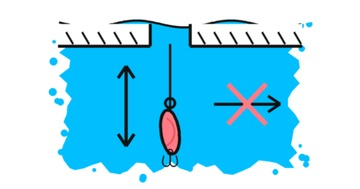
Ice fishing lures: worked vertically
An ice fishing lure differs from other artificial lures not in material or shape but in how it's presented. You don't cast it — you lower it and work it up and down under one spot, and everything else in this section follows from that.
What disappears along with the cast
There's no distance, so there's no problem of casting far enough. There's no horizontal retrieve, so nothing holds the lure at a set depth the way a hardbait's lip does. In place of distance there's a water column: the lure travels down it and back up, and you don't chase the fish — you wait for it.
The branch splits by what creates the movement
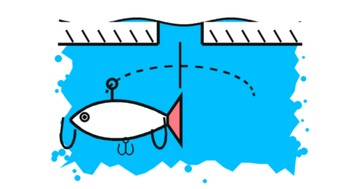
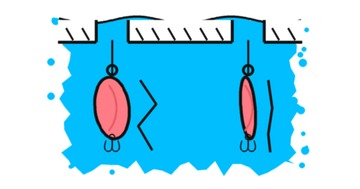
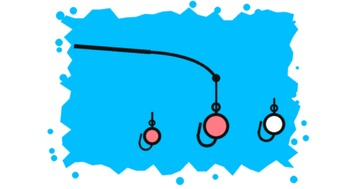
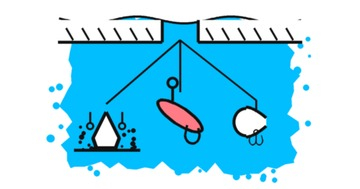
After the lift, a jigging minnow swings out from under the hole and comes back — the lure itself makes the movement. A jigging spoon doesn't move that way: it settles downward, and free fall gives it its action. An ice jig has no movement of its own at all: everything it does comes from the hand, through the spring bobber.
This is the real split inside the section — how much work the lure takes on, and how much it leaves to the angler.
Weight here isn't about distance
In a summer tackle box, weight is for casting distance. Here it's for how fast the lure sinks and whether it can straighten a thin line. That's why ice fishing lures run smaller than summer lures built for the same job, and the lightest of them weigh a fraction of a gram — just enough to straighten the line.
This isn't only about ice
Vertical presentation doesn't need ice: from a boat, a pier or a bridge, the lure works the same way. Ice only removes the last variable — wind can push a boat off the spot, but a hole in the ice stays put. So the cards in this section don't care whether your water freezes.
What carries over from the summer box
Some lures work both ways: lipless hardbaits and heavy soft plastics on a jig head fish vertically just as well as dedicated ice lures. The difference isn't in what you're fishing with but in the tie point — that's what sets the working position in the water: a jigging minnow hangs by the back and sits horizontal, a spoon hangs by the nose and sits vertical, an ice jig hangs by the eye or a through-hole and sits at an angle.
Tackle built for the vertical
The rod here is short, and the reel exists only to hold spare line and change depth — there's nothing to cast. That's exactly why the simplest centrepin reels are still standard in winter tackle, where nothing has to be cast, and winter rods themselves are shorter than any other kind.
What we don't cover here
Ice safety isn't here — that's a separate subject, and no lure changes it. Nor are dates: when and where winter fishing is allowed is set by the regional fisheries authority, not by the class of lure, and those rules differ by region. And there are no “what's biting on” tables — you won't find that kind of chart anywhere in this section.