Jigging minnows: they swing sideways
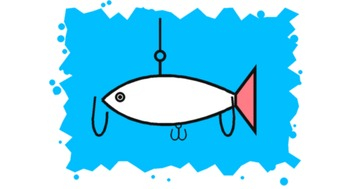
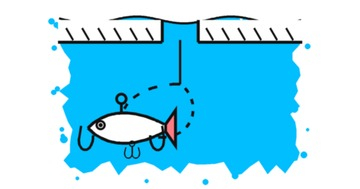
A jigging minnow is a horizontally-hung lure with hooks at the front, the back and underneath. After the lift it doesn't fall straight back — it swings sideways and returns to vertical along a curve.
Why it swings sideways
The tie point sits on the back, roughly at the middle of the body, not at the nose. So the pull isn't head-on the way it is on a hardbait through its lip — it's upward, over the back, and on the lift the minnow breaks forward and sideways instead of running straight. The tail fin turns it back on the way down — that's what makes the curve.
What this gives the angler
Under a single hole, a jigging minnow searches an area, not just a column of water. That's why it's used to find active fish: it checks the circle around the spot faster than a jigging spoon, which stays close to vertical.
Three hooks instead of one
At the front and back, the hooks are fixed into the body for good; a treble hangs underneath. This set catches fish that take the lure from any side — and just as readily catches everything it passes: weed, a snagged net, the edge of the hole.
What it isn't
It isn't a hardbait: it has no lip, and it doesn't hold a depth at all. And it isn't a metal lure: its body is solid and hangs from one end, while this one hangs from the back — and that tie point is what makes the whole difference in action.
Why it hangs level
Hung from the back, the body balances itself and hangs level with no pull from the line. That same balance is what the Ukrainian name for the class, balansyr, points to — and it's the first thing to go when the tie point sits in the wrong place.
The hole limits the size
A jigging minnow goes down through a ready-made hole, and anything wider than it stays on the ice. It's the only lure in this section with real width across the body: the treble underneath and the tail fin add width that a spoon simply doesn't have. That's why it's the only one that might not fit through a narrow hole.
Its colour is paint, not metal
A cast body has no shine of its own: it's dull, and every visible signal on a jigging minnow is paint, an insert or a dot. So the finish here isn't cosmetic — it's part of the build, and it works by the same rules covered in the branch on lure colour and sound.
What's inside this branch
Two cards: what a jigging minnow is made of and how it swims under the hole. The first covers the parts you can't change after buying it; the second covers what the angler does by hand, and how easily that action gets ruined.