Lure sound and vibration
The question “does a lure make noise” is actually two questions, because a fish has two receivers, and they work at different ranges.
The near field
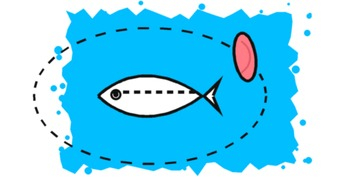
A moving lure pushes water ahead of it and drags water behind. The lateral line feels that movement — an organ that responds to water shifting relative to the fish’s body. It’s short-range and switches on only once the lure is already close.
The far field
Pressure waves travel further and reach the inner ear. This is sound in the usual sense, and it’s the one able to draw a fish to a lure from a range at which no water movement can be felt at all. The line between near and far field isn’t sharp — one channel fades into the other gradually.
Frequency, not loudness
High frequencies die out in water faster than low ones, so it’s the low sound that travels far. Loudness here doesn’t substitute for frequency: a faint high rustle won’t become audible from afar just by making more of it. On top of that, cyprinids have a bony link between the swim bladder and the ear and hear a wider band than pike and perch.
What a lure produces
Three things at once: the body displacing water, balls knocking inside a cavity if there is one, and split rings rattling against the hooks. The last one is heard even in a metal lure, which has no chamber at all — meaning there’s no fully silent lure in the box, none whatsoever.
Why water carries this better than light
Light in water fades fast and vanishes in murk. Vibration passes through both murk and darkness — so at night and in silt it’s the one channel left intact.
What makes noise besides the lure
A boat, footsteps on the bank, a sinker hitting the water, a reel creaking. To the fish it’s the same channel, and on a calm, shallow day the angler’s own noise carries further than the rattle in a hardbait. Approaching quietly matters more than picking a loud model.
Noise doesn’t summon fish across the whole water
The far field gives a fish a direction, not an address: it moves toward the source and then searches by other organs. So the near channel still matters on the spot — a loud lure doesn’t excuse you from working it where the fish is actually holding.
Noise isn’t always an advantage
On heavily pressured water, loud lures work worse than quiet ones — anglers notice this, and it’s exactly why manufacturers release “silent” versions of the same models. There’s no proof here, only a market fact, and we call it that and nothing more.