Hook and lure knots
These are the knots of the business end — the ones attaching line to a hook, a swivel or a lure. The demands on them differ from joining knots: they never have to pass through guides, but they must hold on a metal eye.
Four knots, four different jobs
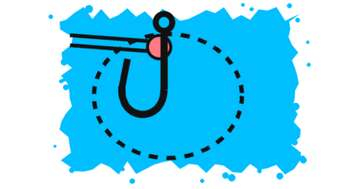
- Palomar — simple and dependable, tied with doubled line.
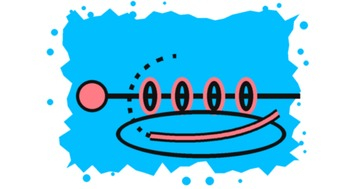
- Clinch — the classic turns knot, the most widely used.
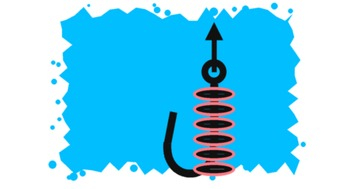
- Snell — tied around the shank rather than only through the eye.
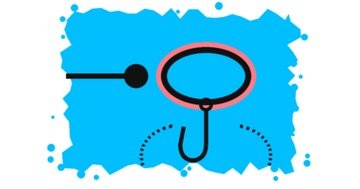
- Loop knot — leaves the lure free to move.
Tight knot or loop is a decision
Most knots pull down tight on the eye and the lure hangs rigidly. A non-slip loop does the opposite: it leaves a ring for the eye to swing in.
The difference shows on lures with an action of their own. A rigid connection damps part of that action; a free loop lets the lure move as designed. Where no action is wanted, a loop only adds a needless element.
The snell stands apart
It is tied not through the eye alone but around the shank, and so it works differently: the pull runs along the shank and turns the hook on the strike. That matters where the bait is large and there is little room for a strike.
This knot needs a hook with a suitable eye — see Hook types.
The knot is tied before it is needed
A hook is changed more often than any other part of a setup: it blunts, opens out, stays in a snag. So a knot from this group has to be tied not once a session but dozens of times, often in a hurry and with cold fingers.
Hence the main criterion is not maximum strength but repeatability. A knot you tie identically in the dark is safer than one that holds more on paper but comes out different every time.
Eye shape limits the choice
A ring eye takes almost every knot in this group. A spade end does not: there is no hole, and the knot holds on the shank itself. That is why a „favourite knot" sometimes suddenly refuses to work — the knot has not changed, the hook has.
The general rules — why a knot takes strength away and why it is wetted — are in Fishing knots.
Trim the tag, but not flush
A seated knot leaves a tag end, and it is shortened so it does not pick up weed and debris. Cutting it flush is risky though: under load the knot draws down a little further, and too short a tag can pull out of the turns.
That is one of the commonest causes of a break „for no reason" — the knot looked right, but there was nothing left holding it.
The material matters too
On slippery braid some of these knots creep and need extra turns; on stiff fluorocarbon they seat less willingly. The same knot is not equally dependable on different materials.