Fly rods: line class and rhythm
Fly fishing works unlike any other method, and that is not an overstatement. In every other type the rod accelerates the lure, and the lure's weight pulls the line out. In fly fishing the fly weighs almost nothing — the weight of the line itself flies, and the fly simply follows.
The consequence: class instead of casting weight
Since the blank is loaded by the line, choosing a rod by lure weight makes no sense. Instead of a casting range there is a class — a number that binds rod and line into one pair. A rod of a given class is built for a line of the same class, and that match decides whether the outfit will cast at all.
The class system is covered in Fly rod classes.
The cast is rhythm, not force
A fly cast is not one movement but a sequence: the line is worked out with false casts back and forth until it has length, and only then released. Through all of that the blank loads and unloads many times over.
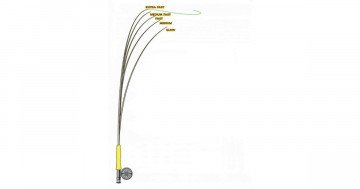
So action means something slightly different here: it governs less how the rod behaves under a fish and more the tempo at which it lets you work. A faster blank demands a crisper, more accurate stroke; a slower one forgives mistakes but will not be hurried.
Why fly fishing is hard at the start
The difficulty is not in the tackle but in the fact that familiar movements do not work. An angler coming from spinning instinctively tries to throw the lure — but there is nothing to throw, the weight is in the line, and a sharp swing simply collapses the cast.
The fly cast has to be learned from scratch regardless of previous experience, and that is the stage where most people give up. A rod of the right class does not shorten the process, but it makes it markedly easier: a blank paired with a line of its own class gives clear feedback, a mismatched one does not.
The reel does not cast here
In fly fishing the reel takes no part in the cast at all — it stores the line and works as a brake when playing a fish. That is why a fly reel is a centrepin by construction and the simplest of all; see Centrepin reels.
It is another difference from every other type, where the reel is an active part of the cast.
Length is chosen for the water, not for range
A long fly rod controls line better on big water; a short one is easier on small overgrown streams with no room to swing. Distance here depends on casting technique more than on blank length. Details in Fly rod length.
What is in this subcategory
Separate articles cover the term itself, construction, action, material and history. Features common to all types — in Fishing rods.